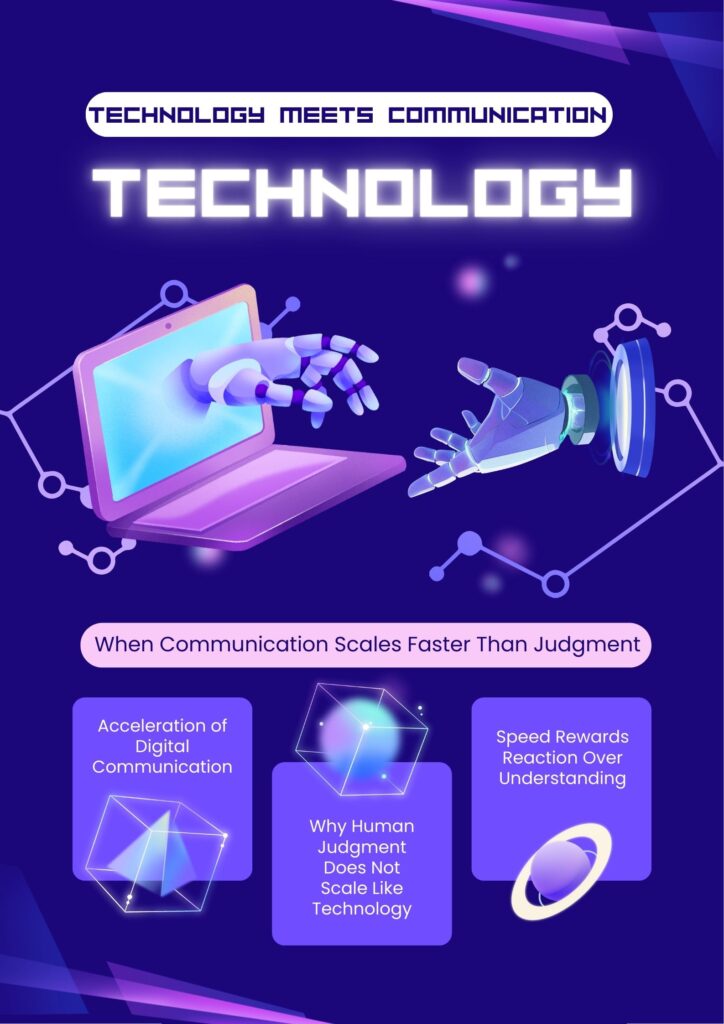
Artificial intelligence has rapidly transitioned from assistive novelty to infrastructural layer in modern communication systems. Across industries, AI tools now draft correspondence, summarize discussions, generate policy documents, mediate customer interactions, and shape public messaging at scale.
The surface improvement is obvious: communication has become faster, more structured, and more linguistically polished.
The deeper question is more complex:
Has AI improved communication itself – or merely optimized its production?
To answer this, it is necessary to distinguish between language generation, relational meaning, and systemic consequence.
Communication as a Sociotechnical System
Communication is not simply the exchange of text. It is a sociotechnical system composed of:
- Linguistic structure
- Emotional calibration
- Relational memory
- Institutional hierarchy
- Cultural norms
- Timing
- Accountability
AI systems operate primarily at the linguistic layer. They predict and generate sequences of words based on probabilistic models trained on large datasets. They do not possess lived experience, relational continuity, or independent moral agency.
When organizations embed AI into communication workflows, they are effectively introducing automation into one layer of a multi-layered system.
The question is whether optimizing one layer strengthens or destabilizes the whole.
Efficiency Gains – Evidence of Mechanical Improvement
Empirical studies indicate that AI-assisted communication increases speed and reduces cognitive load in drafting tasks. Workers report improved productivity when using generative tools for summarization, email drafting, and ideation.
These gains are largely mechanical:
- Reduced time spent structuring documents
- Fewer grammatical errors
- More standardized formatting
- Greater consistency across distributed teams
In structured environments – customer support, technical documentation, transactional communication – these improvements can be significant.
However, mechanical efficiency is not equivalent to communicative effectiveness.
The Context Deficit in Probabilistic Systems
Large language models generate text by predicting likely word sequences given a prompt. While this produces coherent language, it does not entail situational awareness.
Human communication relies heavily on implicit context:
- Prior conversations
- Informal power relationships
- Emotional undercurrents
- Organizational memory
- Cultural expectations
AI models can simulate context when explicitly provided. They cannot independently detect unspoken tensions or evolving relational dynamics.
Research in human-computer interaction consistently shows that users often overestimate AI’s contextual understanding, attributing deeper comprehension than the system actually possesses. This phenomenon-sometimes described as anthropomorphic over-attribution-can lead to misplaced trust.
In practice, this means AI-generated messages may appear appropriate while subtly misaligned with the social environment in which they are deployed.
Emotional Intelligence and the Simulation Problem
AI systems are capable of generating language that resembles empathy. They can mirror supportive phrasing, validate concerns, and adopt tones associated with compassion.
But simulation differs from affective cognition.
Emotional intelligence in humans involves:
- Awareness of one’s own emotional state
- Recognition of others’ emotional cues
- Adjustment of tone based on feedback
- Long-term relational calibration
AI lacks subjective experience and embodied feedback loops. It does not perceive facial expressions, vocal inflection, hesitation, or silence in the way humans do during interaction.
This limitation becomes critical in high-stakes contexts such as:
- Performance evaluations
- Conflict mediation
- Organizational crisis communication
- Mental health support
In such settings, inappropriate emotional calibration can erode trust even if the language appears superficially supportive.
Timing and Strategic Communication
Communication outcomes are frequently determined not only by content but by timing.
Research in organizational behavior highlights the importance of sequencing and pacing in message delivery. Premature disclosure can trigger panic. Delayed communication can foster suspicion. Silence can signal authority or indifference depending on context.
AI systems operate in response to prompts. They do not independently evaluate whether communication should occur at a given moment.
Strategic restraint – the decision not to communicate, or to delay communication – remains a distinctly human function grounded in foresight and risk assessment.
Power Dynamics and Institutional Complexity
Communication inside organizations is shaped by hierarchy.
A message from a senior executive carries structural authority. A peer-to-peer message does not. Word choice interacts with role-based expectations and legal implications.
AI-generated neutrality may obscure these dynamics. While models can adjust tone when prompted, they do not independently assess institutional risk or political sensitivity.
In complex organizations, small phrasing decisions can influence:
- Employee morale
- Legal exposure
- Shareholder confidence
- Public perception
When AI becomes embedded in leadership communication workflows without rigorous oversight, institutions risk substituting fluency for discernment.
Cognitive Offloading and Skill Degradation
One of the less discussed implications of AI-assisted communication is cognitive offloading.
When individuals rely on automated systems to structure arguments, compose sensitive messages, or calibrate tone, they reduce their own engagement in:
- Perspective-taking
- Ethical reasoning
- Emotional regulation
- Anticipation of consequence
Cognitive science suggests that repeated delegation of complex tasks can weaken underlying competencies. Communication is not only expressive; it is developmental.
If high-stakes communication becomes increasingly automated, organizations may experience gradual erosion of human judgment capacity.
The risk is not immediate dysfunction but long-term dependency.
Social Substitution and Relational Effects
Emerging research indicates that heavy reliance on conversational AI may influence interpersonal behavior patterns. Some studies suggest that individuals who engage extensively with AI conversational systems report increased loneliness or reduced human interaction.
While causality remains under investigation, the pattern raises a sociological concern: if AI-mediated interaction replaces rather than supplements human communication, social cohesion may weaken.
Communication technologies historically reshape relational norms. AI introduces a new variable – the presence of an interlocutor that simulates but does not reciprocate human relational complexity.
When AI Strengthens Communication Systems
AI strengthens communication systems when used in constrained, assistive capacities:
- Drafting routine documentation
- Standardizing internal reporting
- Translating technical material
- Supporting multilingual environments
In these domains, efficiency gains outweigh contextual risks.
The key variable is impact sensitivity. Low-consequence communication is more amenable to automation.
When AI Weakens Communication Systems
AI weakens communication when it replaces human judgment in contexts involving:
- Ethical ambiguity
- Emotional volatility
- Institutional risk
- Cultural sensitivity
- Long-term relational consequence
Here, the absence of embodied awareness and moral agency becomes consequential.
Automation at this layer introduces fragility into systems that depend on trust.
A Systems-Level Conclusion
AI makes communication mechanically better. It increases speed, coherence, and accessibility.
It does not make communication structurally wiser.
Communication operates within layered sociotechnical systems where language is only one component. Meaning emerges from context, memory, emotion, timing, and accountability.
As AI becomes embedded in communication infrastructures, the central challenge is governance – ensuring that automation enhances productivity without displacing judgment.
The critical distinction is not between human and machine fluency. It is between language generation and responsibility.
AI can generate text at scale.
It cannot assume the consequences of what that text produces.
Related FAQs
Generative AI improves structural clarity, drafting speed, and consistency in workplace communication. However, it does not independently evaluate relational context, power dynamics, or institutional risk. While output quality may appear polished, effectiveness depends on human oversight to ensure alignment with organizational culture and stakeholder expectations.
AI can model patterns associated with emotional language, but it does not possess subjective awareness or embodied perception. Emotional nuance in human communication depends on contextual cues, relational history, and real-time feedback. AI simulates emotional tone; it does not experience or interpret emotional states.
Over-reliance on AI in high-stakes contexts—such as performance reviews, layoffs, crisis messaging, or conflict mediation—can introduce risks related to tone misalignment, ethical oversight, and reputational exposure. Sensitive communication requires contextual judgment and accountability that automated systems cannot independently provide.
AI reduces the effort required for drafting and formatting messages but does not eliminate the need for communication skills. In fact, as automation increases, the relative importance of contextual awareness, empathy, timing, and ethical reasoning may become more significant. Human judgment remains essential.
Trust depends on perceived authenticity, transparency, and accountability. If AI-generated communication feels impersonal or misaligned with lived experience, trust may decline. Conversely, when AI is used responsibly to enhance clarity without replacing human oversight, it can support more consistent messaging.
Emerging research suggests that increased interaction with AI systems may influence social behavior and communication norms. While AI can supplement human interaction, excessive reliance may reduce direct interpersonal engagement, potentially affecting relational depth and emotional development.
AI-assisted communication involves human review, editing, and decision-making before messages are delivered. AI-automated communication involves minimal or no human intervention. The distinction is significant, as assisted models preserve accountability and contextual oversight, whereas automated models increase systemic risk.
AI is likely to continue improving in linguistic fluency and contextual modeling. However, communication is not solely linguistic; it involves responsibility, relational continuity, and ethical consequence. Full replacement would require machines to replicate human judgment, which remains beyond current capabilities.