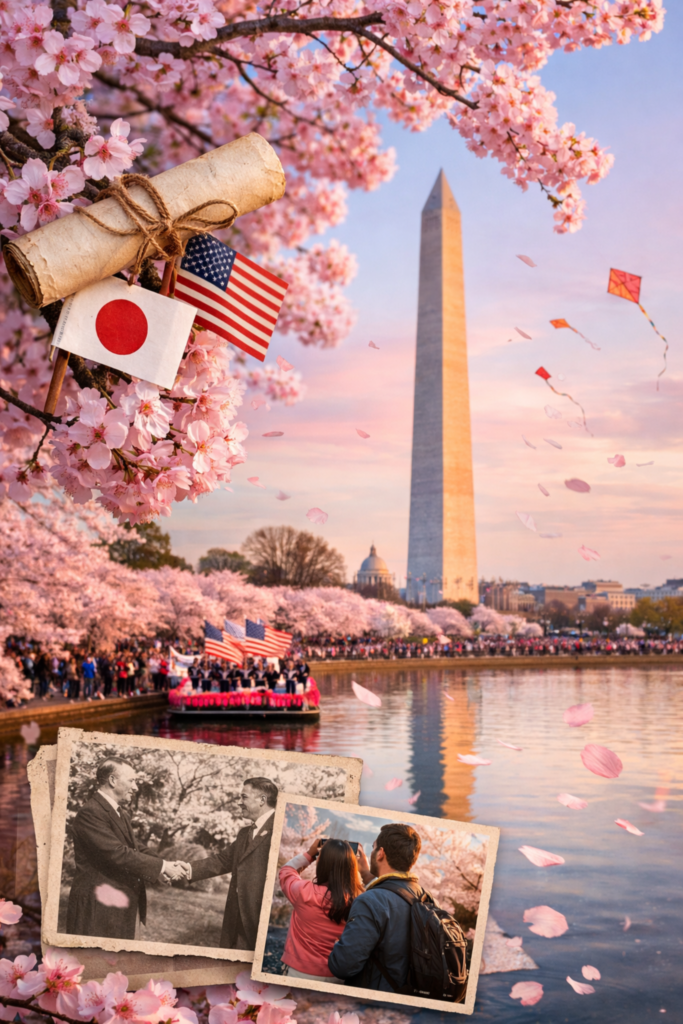
Every spring, something quiet yet powerful happens in Washington, D.C.. Thousands of cherry trees bloom around the Tidal Basin, drawing visitors into a shared moment of stillness, color, and collective attention. The event is known as the National Cherry Blossom Festival.
Dates – March 20 to April 12, 2026 (Tentative)
Location – Washington, D.C.
But beneath the petals, something deeper unfolds.
This is not just a seasonal celebration. It is a living example of how communication works across time – how gestures outlive their senders, how symbols carry meaning beyond language, and how shared presence creates understanding without instruction.
At Message Valley, we look at communication not as words alone, but as systems of timing, intention, relationship, and impact. The cherry blossoms offer a case study in all four.
A Gift That Never Stopped Speaking
In 1912, Japan gifted more than 3,000 cherry trees to the United States – a diplomatic gesture meant to symbolize friendship between nations. That moment is often retold as history. But history, when repeated annually, becomes communication.
The trees were not just plants.
They were a message.
What makes this remarkable is durability. Diplomatic statements are often forgotten. Speeches fade. Agreements change. But the blossoms return every year, restating the original intention – not through text, but through renewal.
The original senders are gone. The original recipients are gone.
Yet the message continues.
This is communication operating across generations.
It shows us something fundamental:
Meaning lasts when it is embedded in ritual.
Nature as a Language System
Cherry blossoms are brief. Their bloom lasts only days at peak. Their fragility is central to their impact. People gather because they know the moment will pass.
Scarcity sharpens attention.
In communication theory, timing changes meaning. A message delivered too often becomes noise. A message that appears briefly becomes precious. The blossoms operate on seasonal timing – predictable, yet never guaranteed. Weather shifts the peak. Climate alters duration. Uncertainty intensifies awareness.
When people stand beneath the trees, they are responding to more than beauty. They are responding to impermanence.
And impermanence communicates urgency.
Not verbally – emotionally.
Collective Attention as Meaning
During the festival, thousands of strangers photograph the same trees from slightly different angles. Social feeds fill with similar pink canopies. At first glance, repetition might seem redundant.
But repetition builds cultural memory.
When many people focus on the same object at the same time, synchronization occurs. Shared attention creates a temporary social alignment. The blossoms become a focal point through which individuals experience togetherness without coordination.
No one instructs visitors on how to feel.
No official message dictates interpretation.
Yet meaning forms collectively.
Communication does not always require central control. Sometimes it emerges from simultaneous presence.
Ceremony as Structured Communication
The festival includes parades, performances, and cultural exchanges. These are not simply entertainment segments. They are structured rituals reinforcing narrative: friendship, continuity, shared heritage.
Ritual slows communication down.
- It adds formality.
- It signals importance.
- It marks boundaries between ordinary days and symbolic days.
When communities gather annually under the same trees, the repetition transforms the event into tradition. And tradition stabilizes meaning. It protects a message from distortion by embedding it inside predictable structure.
This is how communication survives scale.
Digital Amplification and Modern Meaning
Today, the blossoms are no longer confined to the Tidal Basin. They circulate globally through images, videos, captions, and commentary. The festival now operates within both physical and digital ecosystems.
This raises a modern question:
Does documenting a moment dilute it – or expand it?
Photography can shift attention from presence to performance. Yet it also extends participation. Someone across the world, scrolling through a feed, becomes part of the bloom cycle.
Technology does not replace the message. It redistributes it.
The blossoms still bloom in one location. But their symbolic reach multiplies.
Communication adapts. The medium changes. The core intention remains.
What the Festival Ultimately Teaches Us
The National Cherry Blossom Festival demonstrates that communication:
- Can be planted.
- Can outlive its creators.
- Can function without constant explanation.
- Can rely on timing rather than volume.
- Can be reinforced through ritual rather than repetition of slogans.
Most importantly, it shows that meaning strengthens when people encounter it together.
- The blossoms do not argue.
- They do not persuade.
- They do not instruct.
They invite.
And invitation is one of the most powerful forms of communication. It leaves space for interpretation while guiding shared direction.
Communication That Returns
Every year, the trees bloom again. The original diplomatic gesture is renewed without renegotiation. No updated statement is required. The cycle itself is the message.
In a time when communication is often immediate, reactive, and disposable, the cherry blossoms offer a different model:
Slow.
Seasonal.
Symbolic.
Enduring.
They remind us that meaningful communication is not measured by frequency, but by continuity.
And sometimes, the most powerful messages are the ones that do not speak loudly –
but return, precisely when expected, carrying the same intention forward.
That is when flowers become diplomacy.
National Cherry Blossom Festival 2026 FAQs
The National Cherry Blossom Festival is expected to take place from late March through mid-April 2026, with peak bloom typically occurring in late March or early April, depending on weather conditions.
The festival is held in Washington, D.C., primarily around the Tidal Basin, where thousands of cherry trees bloom each spring.
The cherry trees were originally gifted by Japan in 1912 as a symbol of friendship between the United States and Japan, establishing a long-standing diplomatic and cultural connection.
Beyond its visual appeal, the festival represents international diplomacy, seasonal renewal, and shared public celebration. It demonstrates how natural events can function as symbolic communication within society.
The event transforms seasonal change into a collective experience. Through parades, performances, and public gathering, the bloom becomes a shared symbol of renewal, cooperation, and continuity.
No. While the blooming trees are central, the festival includes cultural performances, educational programs, community events, and international showcases that reinforce its diplomatic and cultural significance.
Peak bloom marks the period when 70% of the blossoms are open. It attracts the largest public gatherings and symbolizes the fleeting yet powerful nature of shared seasonal experience.