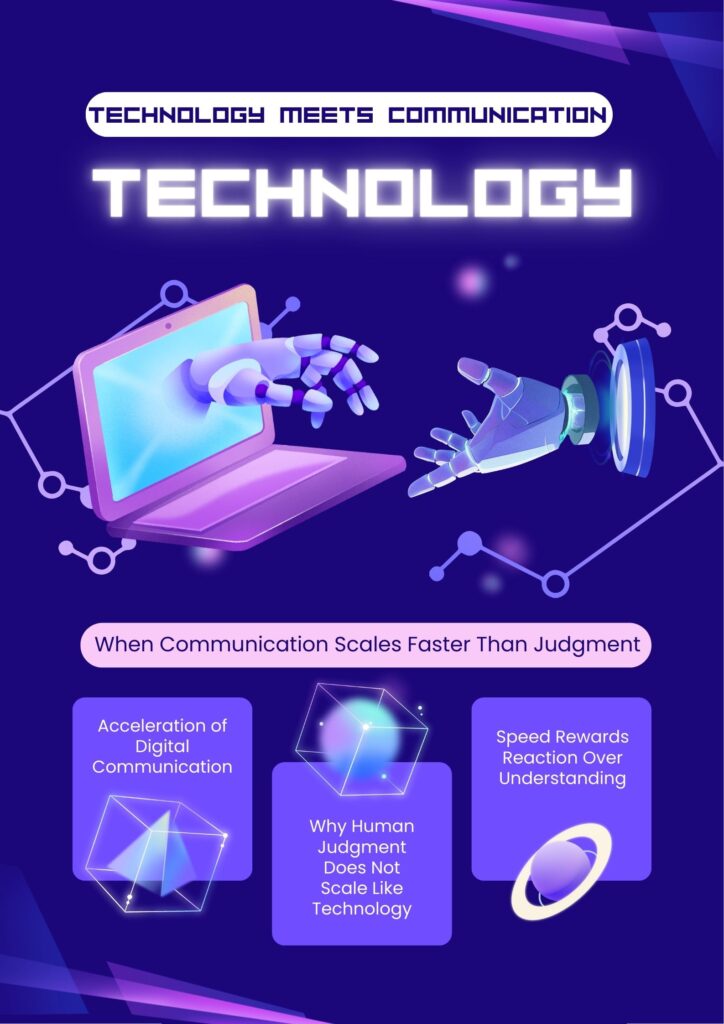
Technology is often described as a tool for sending messages faster, farther, and more efficiently. Emails replace letters. Messages replace calls. Platforms replace rooms. Automation replaces effort.
But technology does more than carry messages.
It shapes how meaning is formed, perceived, and understood.
Every communication tool quietly influences what gets said, how it is expressed, who receives it, and how it is interpreted. Technology does not simply transmit language. It mediates meaning.
Understanding this difference is essential in a world where communication is increasingly digital.
Messages Travel, Meaning Changes
A message is the visible content: the words, symbols, or signals sent from one point to another. Meaning, however, is what the receiver understands, feels, and responds to.
In face-to-face communication, meaning is shaped by tone, timing, body language, shared environment, and relationship history. Technology removes or reshapes many of these layers.
A short sentence sent through a digital channel can feel neutral, urgent, dismissive, or cold depending on the medium, timing, and expectations surrounding it. The words remain the same. The meaning does not.
This is mediation.
Technology inserts itself between sender and receiver, influencing interpretation whether we intend it to or not.
Medium Is Not Neutral
Different technologies create different communication conditions.
An email suggests formality and distance. A chat message suggests immediacy. A public post invites interpretation from many audiences at once. An automated response signals efficiency but not presence.
Each medium carries assumptions about urgency, tone, and intent. When people choose a communication tool, they are also choosing a framework that shapes meaning before the message is even read.
Technology is never a neutral container.
It frames the message before the words begin.
Speed Changes Meaning
One of the most powerful ways technology mediates communication is through speed.
Instant delivery creates expectations of instant response. Delays are interpreted emotionally. A quick reply may feel attentive. A slow one may feel dismissive or avoidant, even when no such intent exists.
Speed compresses reflection.
When communication becomes immediate by default, messages are often sent before they are fully considered. Meaning becomes reactive rather than deliberate. Judgment has less time to operate.
Technology does not just make communication faster.
It changes how quickly meaning is assumed.
Scale Alters Interpretation
Digital communication allows messages to scale far beyond their original audience.
A message written for one person may be forwarded to many. A statement meant for a moment may circulate indefinitely. A casual remark can be interpreted as a position.
When communication scales, meaning becomes unstable.
Different audiences bring different contexts, expectations, and sensitivities. Technology allows messages to travel without carrying the boundaries they were created within.
This is not a failure of language.
It is a consequence of scale without shared context.
Automation Shapes Tone Before We Choose It
Automated systems increasingly assist with communication. Suggested replies, predictive text, templates, and AI-generated content offer speed and consistency.
But these systems also shape tone.
When a system suggests phrasing, it subtly guides expression. Over time, people adapt to the language the system prefers. Communication becomes smoother, but also more uniform.
The risk is not that automation writes messages.
The risk is that it quietly standardizes meaning.
Judgment involves choosing not only what to say, but how to say it in a specific moment. Automation optimizes for efficiency, not appropriateness.
Meaning Requires Human Judgment
Meaning is not contained in words alone.
It emerges from intention, context, timing, and responsibility.
Technology cannot fully account for emotional nuance, power dynamics, or moral consequence. It cannot feel when a message is premature, inappropriate, or unnecessary.
Human judgment fills these gaps.
When communication relies too heavily on systems, meaning becomes thinner. Messages may be clear but misaligned. Efficient but insensitive. Correct but wrong for the moment.
Technology can assist communication, but it cannot replace the human role in shaping meaning.
Why Misunderstanding Is Increasing
Despite better tools, misunderstanding remains widespread.
This is not because people communicate less.
It is because meaning is increasingly mediated by systems that prioritize speed, scale, and efficiency over understanding.
When messages are sent quickly, widely, and through constrained formats, meaning becomes fragile. Small ambiguities multiply. Emotional signals disappear. Assumptions fill the gaps.
Technology makes communication easier to send, but harder to interpret accurately.
Responsibility in Mediated Communication
When technology mediates meaning, responsibility becomes more complex.
Who is responsible for how a message is interpreted when it is shaped by platforms, algorithms, and automation? Who owns the outcome when a message causes confusion or harm?
These questions matter because meaning has consequences. It influences trust, relationships, decisions, and culture.
Human responsibility does not disappear because systems are involved. In fact, it becomes more important.
Judgment is the act of taking responsibility for meaning, not just messaging.
Using Technology With Awareness
The goal is not to reject communication technology.
It is to use it with awareness.
This means recognizing that choosing a tool is also choosing a tone. That speed changes interpretation. That scale alters meaning. That automation influences expression.
It also means knowing when not to communicate. When to pause. When to choose a different medium. When silence is more responsible than expression.
Technology mediates meaning whether we acknowledge it or not. Awareness allows us to respond thoughtfully rather than react automatically.
Why This Understanding Matters
In a world where messages are easy to produce, meaning becomes the scarce resource.
Miscommunication is rarely caused by a lack of words. It is caused by a lack of judgment about how those words will land.
Technology will continue to evolve. Communication will continue to accelerate. But meaning will always require human care.
Because communication that matters is not defined by how efficiently messages are sent – but by how carefully meaning is shaped.