Communication has never been easier to produce.
It has also never been harder to manage responsibly.
Digital communication tools allow messages to be created, duplicated, automated, and distributed instantly. A single statement can reach thousands – sometimes millions – of people within moments. While technology has dramatically increased the speed and reach of communication, it has not expanded human judgment at the same pace.
This growing imbalance – where communication scales faster than judgment – is becoming one of the most important challenges in the modern digital world.
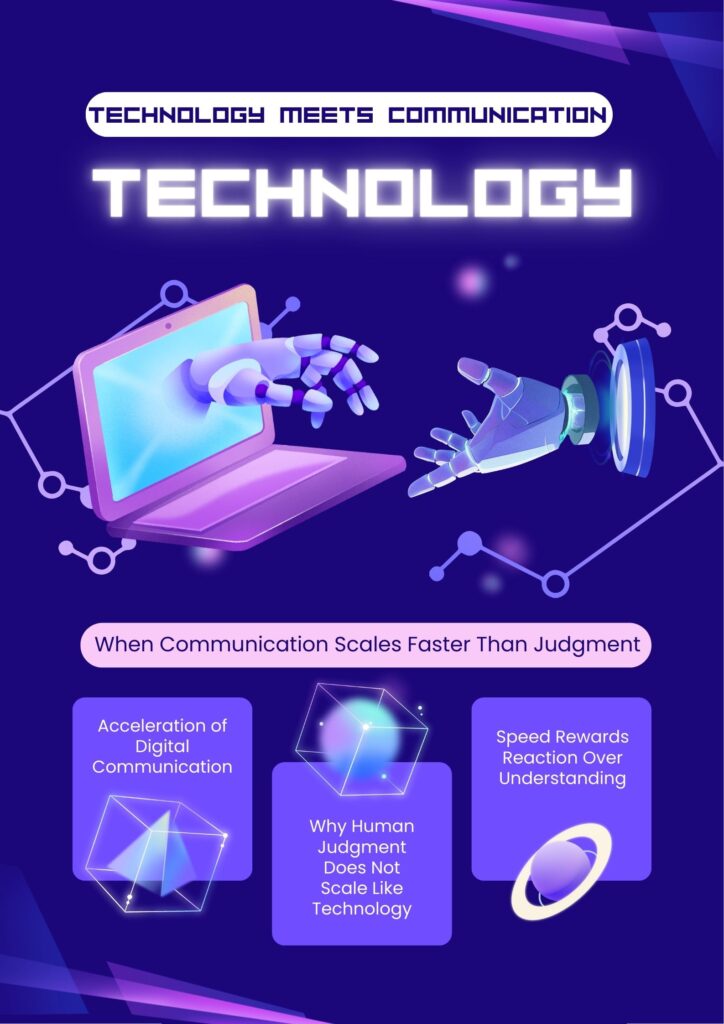
The Acceleration of Digital Communication
For most of history, communication moved at a human pace. Writing, publishing, and speaking publicly required effort, access, and deliberation. These limitations acted as natural brakes. They did not guarantee wisdom, but they created space for reflection.
Modern communication technology has removed many of those constraints.
Email, instant messaging, social platforms, automation tools, and AI-driven systems enable expression without delay. Messages can be scheduled, generated, and amplified without the sender being present when they are received. Platforms reward speed, consistency, and engagement – not timing, nuance, or responsibility.
As communication becomes faster and more scalable, the ability to judge its impact often lags behind.
Why Human Judgment Does Not Scale Like Technology
Judgment is not mechanical.
It depends on context, emotional awareness, relationships, power dynamics, and consequence. It requires understanding not only what is being said, but how, when, why, and to whom.
Technology excels at repetition and distribution. Judgment does not.
When communication systems scale rapidly, they often bypass the pause required for thoughtful evaluation. This creates an environment where messages move faster than their meaning can be assessed.
The Erosion of Responsibility in Automated Communication
One of the earliest consequences of scaled communication is the quiet erosion of responsibility.
When messages are automated, templated, or generated by systems, accountability becomes unclear. Who owns the meaning of a message when it is created by software, approved by a workflow, and delivered by an algorithm?
Phrases like “it was automated” or “the system sent it” subtly remove human ownership. Judgment, which traditionally lives inside responsibility, becomes optional rather than essential.
In communication systems built for scale, responsibility is often distributed so widely that it effectively disappears.
How Context Breaks at Scale
Context is fragile.
Scale is not.
Digital messages travel easily, but context does not. A message written for one audience is forwarded to another. A statement meant for a moment is read long after that moment has passed. Tone collapses. Intent is inferred without shared understanding.
As communication scales, it becomes increasingly detached from the conditions that gave it meaning. This leads to misunderstanding, conflict, and misinterpretation – often without malicious intent.
When communication moves faster than judgment, context becomes optional, and then invisible.
Speed Rewards Reaction Over Understanding
Modern communication systems prioritize responsiveness. Fast replies are interpreted as engagement. Immediate reactions signal relevance. Silence is often misread as disinterest.
Judgment, however, requires time.
When speed becomes the primary metric, reflection is treated as inefficiency. Thoughtfulness looks like delay. People learn to respond quickly rather than carefully, not because they lack awareness, but because the system rewards immediacy.
This dynamic encourages reaction instead of understanding – a trade-off that quietly reshapes communication norms.
The Illusion of Clarity in Technology-Mediated Messages
Digital communication often feels precise. Typed words appear deliberate. Structured messages look authoritative. Automated phrasing sounds confident.
But clarity of form does not guarantee clarity of meaning.
A message can be perfectly written and deeply misunderstood. Technology is excellent at producing surface-level coherence, even when emotional or contextual alignment is missing.
As communication scales, this illusion of clarity becomes increasingly persuasive – and increasingly misleading.
When Volume Replaces Meaning
Scaled communication environments reward what travels well. Frequency, emotional intensity, and simplicity outperform nuance and restraint. Messages compete for attention rather than understanding.
Judgment, however, often asks the opposite question: Should this be said at all?
When communication scales faster than judgment, volume begins to replace meaning. Silence loses its legitimacy. Restraint feels unnatural. Communication becomes constant, but thinner.
Automation Without Moral Weight
Automation and AI can replicate patterns, optimize delivery, and personalize language. What they cannot do is carry moral responsibility.
Judgment involves ethical awareness. It considers potential harm, long-term impact, and unintended consequences. Automated communication systems operate without this internal compass unless humans deliberately provide it.
The risk is not that technology communicates – it is that humans stop actively judging what technology is allowed to communicate on their behalf.
The Normalization of Thoughtless Communication
Over time, the effects of scaled communication become normalized. Misunderstanding feels inevitable. Emotional misalignment becomes routine. Expectations lower.
This is not because people value meaning less. It is because systems reward speed over judgment, and people adapt to the incentives around them.
What begins as convenience gradually reshapes standards.
Reintroducing Judgment Into Scaled Communication
The answer is not to reject communication technology.
It is to reintroduce judgment where systems remove it.
This means slowing decisions, not tools. Creating intentional pauses. Asking whether a message needs to scale at all. Choosing responsibility over efficiency when stakes are high.
Not every message benefits from reach. Some are meant for specific people, specific moments, and specific contexts. Scale changes meaning – it does not simply extend it.
Why This Matters in a Digital World
Communication shapes trust, relationships, organizations, and culture. When it moves faster than judgment, the damage accumulates quietly. Misalignment grows. Cynicism increases. Meaning erodes.
As communication technology continues to advance, the human role becomes more important, not less.
Because communication that matters is not defined by how far it travels – but by what it does when it arrives.