
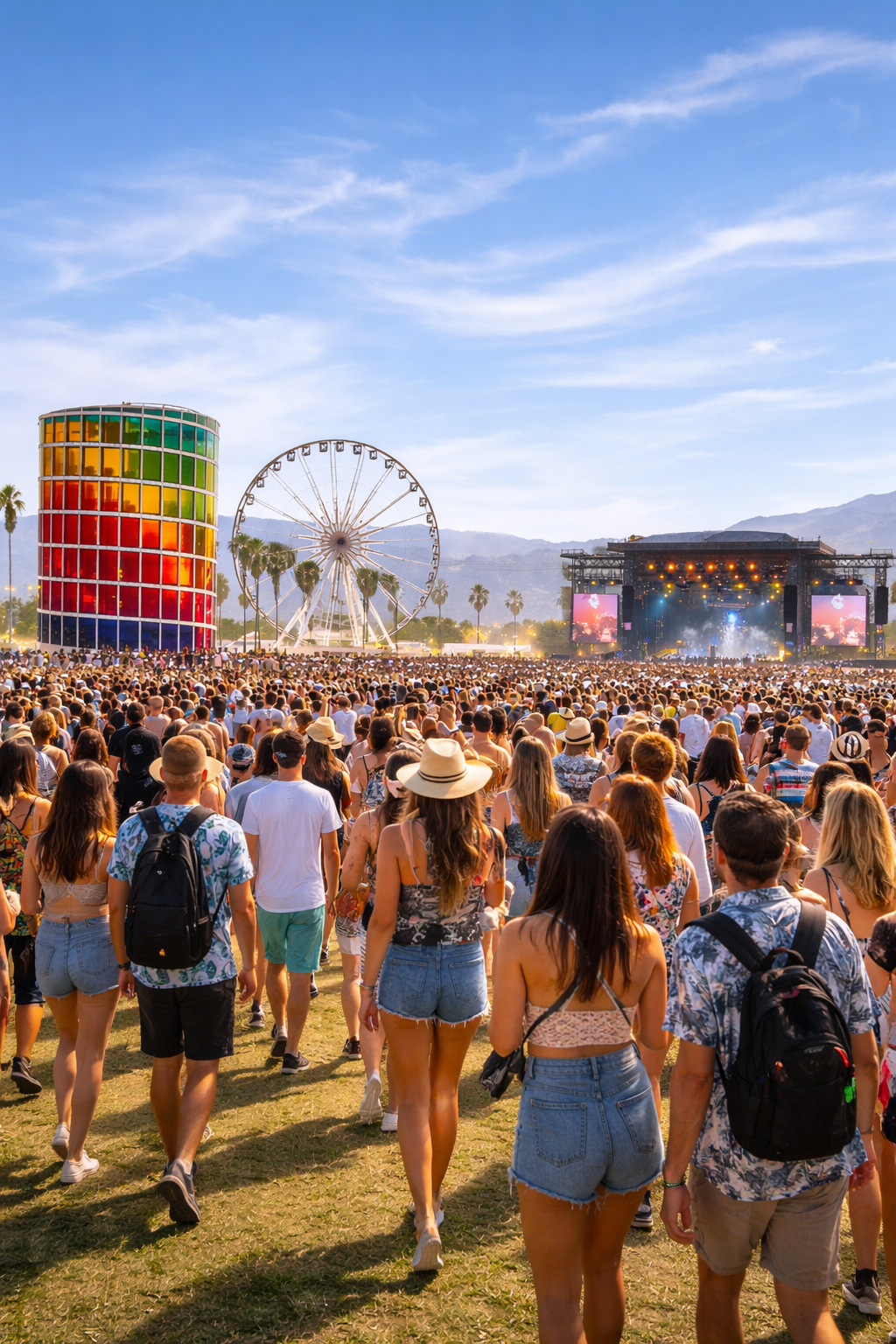
Coachella Valley Music and Arts Festival 2026 – Where Music Becomes a Shared Cultural Moment
Every April, the California desert transforms into a temporary city of sound, color, and connection. The Coachella Valley Music and Arts Festival returns in April 2026 to the iconic Empire Polo Club in Indio, drawing music lovers, artists, creators, and cultural observers from across the world.
But Coachella is more than a lineup announcement or a trending hashtag. It is a cultural ritual – a shared moment where music, art, identity, and technology converge to create something larger than any individual performance.
The Desert as a Stage for Global Sound
Coachella’s power lies in its range. Across multiple stages, global superstars share space with emerging artists, electronic producers, indie bands, hip-hop innovators, and experimental performers. Genres blend. Audiences overlap. Boundaries soften.
For three days – across two consecutive weekends – strangers sing the same lyrics, move to the same beat, and experience the same emotional crescendo under open skies. In a fragmented digital world, this physical convergence feels rare and meaningful.
Music here becomes a language of collective participation.
Art That Redefines Space
While music anchors the festival, large-scale art installations transform the desert landscape into an immersive environment. Monumental sculptures, interactive structures, and architectural experiments rise from the sand, encouraging exploration and reflection.
Art at Coachella is not decorative — it is experiential. It invites festival-goers to engage with space differently, to pause between performances, to encounter creativity beyond sound. The installations become landmarks for memory: “Meet me by the giant structure,” or “Remember that glowing sculpture at sunset?”
These works shape how the festival is navigated, photographed, and remembered.
A Ritual of Modern Identity
Coachella has evolved into more than a music festival; it is a mirror of contemporary culture. Fashion, digital storytelling, influencer culture, and live streaming all intersect here. What happens in the desert does not stay in the desert — it radiates across social platforms within seconds.
Yet beneath the filters and curated posts, something deeper unfolds:
- People travel across states and continents to be present.
- Communities form temporarily and dissolve gracefully.
- Moments become shared references long after the weekend ends.
In this sense, Coachella operates as a modern ritual — a cyclical gathering that reinforces belonging, creativity, and cultural participation.
Why Coachella 2026 Matters
Each edition reflects the cultural climate of its time. The artists booked, the themes of the installations, the conversations sparked online – all offer insight into what audiences value now.
In 2026, Coachella continues to demonstrate how large-scale events function as communication systems:
- Music communicates emotion.
- Art communicates imagination.
- Fashion communicates identity.
- Attendance communicates belonging.
Meaning is not fixed; it emerges from participation.
When thousands stand beneath the same desert sky, what is created is not just entertainment — it is collective memory.
Planning to Attend
If you’re considering attending Coachella 2026:
Location: Empire Polo Club, Indio, California
Format: Two identical three-day weekends in April
Weather: Warm desert days, cooler evenings
Accommodation: Hotels, resorts, Airbnb rentals, and on-site camping options
Transportation: Shuttle passes, rideshare services, and nearby airport access (Palm Springs International Airport)
Booking early is essential, as tickets and accommodation sell out quickly.
Coachella Valley Music and Arts Festival 2026 FAQs
The festival traditionally takes place over two consecutive weekends in April 2026 at the Empire Polo Club in Indio, California.
It is hosted at the Empire Polo Club in Indio, California, located in the Coachella Valley region of Southern California.
No. Both weekends typically feature the same lineup and stage schedule, giving attendees flexibility in choosing their preferred dates.
Coachella blends large-scale art installations, diverse global music, fashion culture, and digital storytelling into one immersive environment.
Yes. On-site camping is one of the most popular ways to experience the festival and allows deeper immersion in the community atmosphere.
While primarily designed for adults, the festival does not have a strict age limit. However, the scale, crowd size, and atmosphere are best suited for mature audiences.