Easter and Good Friday are two of the most important days in the Christian calendar, yet many people often confuse their meaning, purpose, and traditions. While both are closely connected, they represent very different moments with unique significance.
Understanding the difference between Easter and Good Friday helps you appreciate the deeper meaning behind the season, whether you’re observing it spiritually, celebrating with family, or simply learning about its traditions.
If you’re planning gatherings around the holiday, you can also explore ideas like Easter dinner ideas or share thoughtful words from your Easter wishes and messages collection to make the occasion more meaningful.
What Is Good Friday?
Good Friday is a solemn day that commemorates the crucifixion of Jesus Christ and his sacrifice for humanity. It is observed during Holy Week and typically falls on the Friday before Easter Sunday.
Good Friday represents sacrifice, suffering, and redemption. It marks the moment when Jesus was crucified, making it a day of deep reflection and spiritual significance.
Many people observe Good Friday through church services, prayer, and quiet reflection. Some also fast or avoid certain foods as a form of remembrance. Unlike Easter, it is not a celebratory day but a time for pause, gratitude, and reflection.
What Is Easter Sunday?
Easter Sunday celebrates the resurrection of Jesus Christ from the dead. It is the most joyful and significant day in Christianity, symbolizing hope, renewal, and new life.
Easter represents victory over death and the promise of new beginnings. It is a celebration of faith and a reminder of hope.
The day is widely celebrated with church services, family gatherings, and festive traditions. Many families plan activities like Easter egg hunt ideas or decorate their homes with inspiration from Easter centerpiece ideas, making it both meaningful and joyful.
Easter vs Good Friday: Key Differences
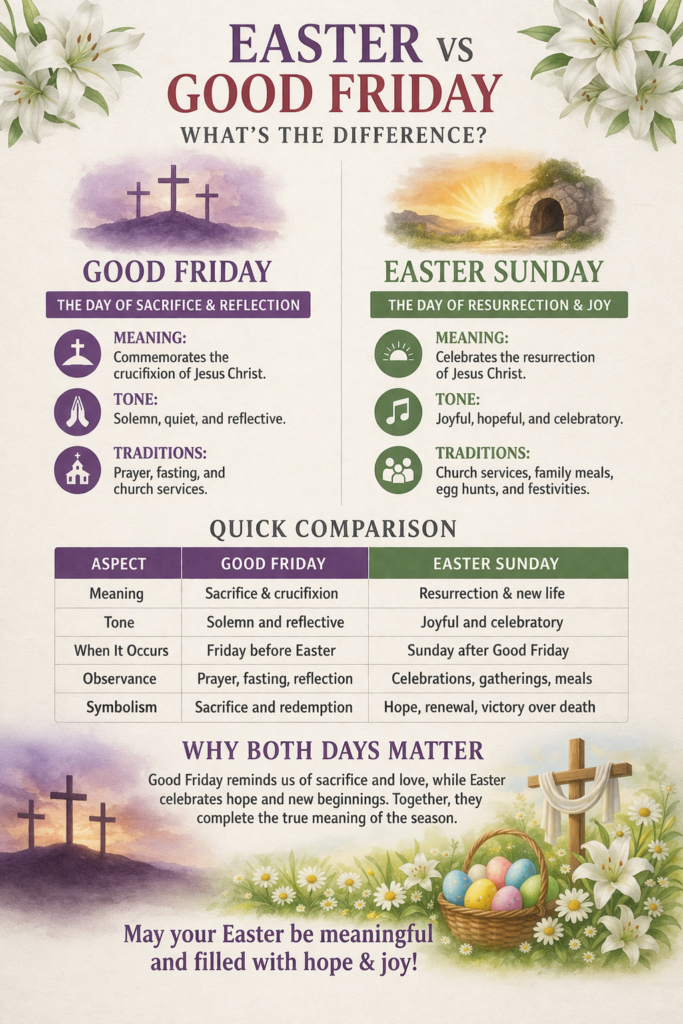
Good Friday and Easter differ in both meaning and mood. Good Friday focuses on sacrifice and suffering, while Easter celebrates resurrection and joy. One is quiet and reflective, while the other is filled with celebration and togetherness.
The traditions also differ. Good Friday is marked by prayer, fasting, and reflection, whereas Easter includes meals, gatherings, and activities with loved ones.
Easter vs Good Friday: Quick Comparison
Easter and Good Friday are two of the most important days in the Christian calendar, yet many people often confuse their meaning, purpose, and traditions. While both are closely connected, they represent very different moments with unique significance.
Understanding the difference between Easter and Good Friday helps you appreciate the deeper meaning behind the season, whether you’re observing it spiritually, celebrating with family, or simply learning about its traditions.
What Is Good Friday?
Good Friday is a solemn day that commemorates the crucifixion of Jesus Christ and his sacrifice for humanity. It is observed during Holy Week and typically falls on the Friday before Easter Sunday.
Good Friday represents sacrifice, suffering, and redemption. It marks the moment when Jesus was crucified, making it a day of deep reflection and spiritual significance.
Many people observe Good Friday through church services, prayer, and quiet reflection. Some also fast or avoid certain foods as a form of remembrance. Unlike Easter, it is not a celebratory day but a time for pause, gratitude, and reflection.
What Is Easter Sunday?
Easter Sunday celebrates the resurrection of Jesus Christ from the dead. It is the most joyful and significant day in Christianity, symbolizing hope, renewal, and new life.
Easter represents victory over death and the promise of new beginnings. It is a celebration of faith and a reminder of hope.
The day is widely celebrated with church services, family gatherings, and festive traditions. Many families plan activities like Easter egg hunt ideas or decorate their homes with inspiration from Easter centerpiece ideas, making it both meaningful and joyful.
Easter vs Good Friday: Key Differences
Good Friday and Easter differ in both meaning and mood. Good Friday focuses on sacrifice and suffering, while Easter celebrates resurrection and joy. One is quiet and reflective, while the other is filled with celebration and togetherness.
The traditions also differ. Good Friday is marked by prayer, fasting, and reflection, whereas Easter includes meals, gatherings, and activities with loved ones.
Easter vs Good Friday: Quick Comparison
| Aspect | Good Friday | Easter Sunday |
|---|---|---|
| Meaning | Commemorates the crucifixion of Jesus Christ | Celebrates the resurrection of Jesus Christ |
| Tone | Solemn and reflective | Joyful and celebratory |
| Significance | Represents sacrifice and redemption | Represents hope, renewal, and new life |
| When It Occurs | Friday before Easter | Sunday after Good Friday |
| Observance | Prayer, fasting, church services | Celebrations, church services, gatherings |
| Traditions | Quiet reflection and fasting | Egg hunts, meals, decorations, family time |
| Symbolism | Sacrifice and suffering | Victory over death and new beginnings |
| Cultural Role | Primarily religious | Religious and widely cultural |
Why Good Friday Comes Before Easter
The order of these two days is essential to their meaning. Good Friday represents the sacrifice, while Easter represents the triumph that follows. Without Good Friday, the significance of Easter would not be complete.
This sequence reflects a powerful message that life often moves from struggle to renewal, from reflection to joy, and from sacrifice to hope.
How People Observe Both Days Today
In the United States, people observe Good Friday and Easter in different ways depending on their beliefs and traditions.
Some focus on spiritual practices such as attending church services and sharing meaningful expressions like Happy Easter wishes for pastor messages, quotes, and blessings.
Others combine reflection with celebration by planning meals, organizing gatherings, and preparing for Easter Sunday using ideas from Easter dinner ideas or checking guides like what’s open on Easter for convenience.
The Role of Traditions in Modern Easter
While Good Friday remains more solemn, Easter has become both a religious and cultural celebration.
Modern traditions include family meals, gift exchanges inspired by Easter gifts for adults, and activities like egg hunts and decorating.
You can also add a creative and meaningful touch by using ideas from Easter egg decoration ideas with messages, blending tradition with personalization.
Making the Season More Meaningful
Understanding the difference between Good Friday and Easter allows you to approach the season with deeper awareness and intention.
You can make these days more meaningful by reflecting on their significance, spending time with loved ones, and sharing thoughtful messages.
For example, sharing words from Easter wishes for family or Easter day wishes for friends can help express the spirit of the season.
Easter and Good Friday Explained Simply
Good Friday and Easter are not separate events but two parts of the same story. Good Friday represents sacrifice and reflection, while Easter represents joy and renewal.
Together, they capture the full meaning of the season and remind us of the journey from hardship to hope.
Whether you observe them spiritually or culturally, understanding their difference adds depth to your celebration and helps you connect more meaningfully with the occasion.
Related FAQs
The main difference is that Good Friday commemorates the crucifixion of Jesus Christ and is observed as a solemn day of reflection, while Easter celebrates his resurrection and is a joyful day marking hope and new life.
Good Friday is called “Good” because it represents the ultimate sacrifice of Jesus Christ for humanity’s redemption. Despite the suffering, it is seen as a day that led to hope, salvation, and the resurrection celebrated on Easter.
No, Good Friday is observed quietly with prayer, fasting, and reflection, whereas Easter is celebrated with joy through church services, family gatherings, meals, and activities like egg hunts.
Good Friday and Easter are part of the same story in Christianity. Good Friday marks the crucifixion, while Easter marks the resurrection, showing the journey from sacrifice to renewal and hope.
Easter follows Good Friday because it represents the resurrection of Jesus Christ, which occurred three days after his crucifixion. This sequence is central to the meaning of the Easter story.