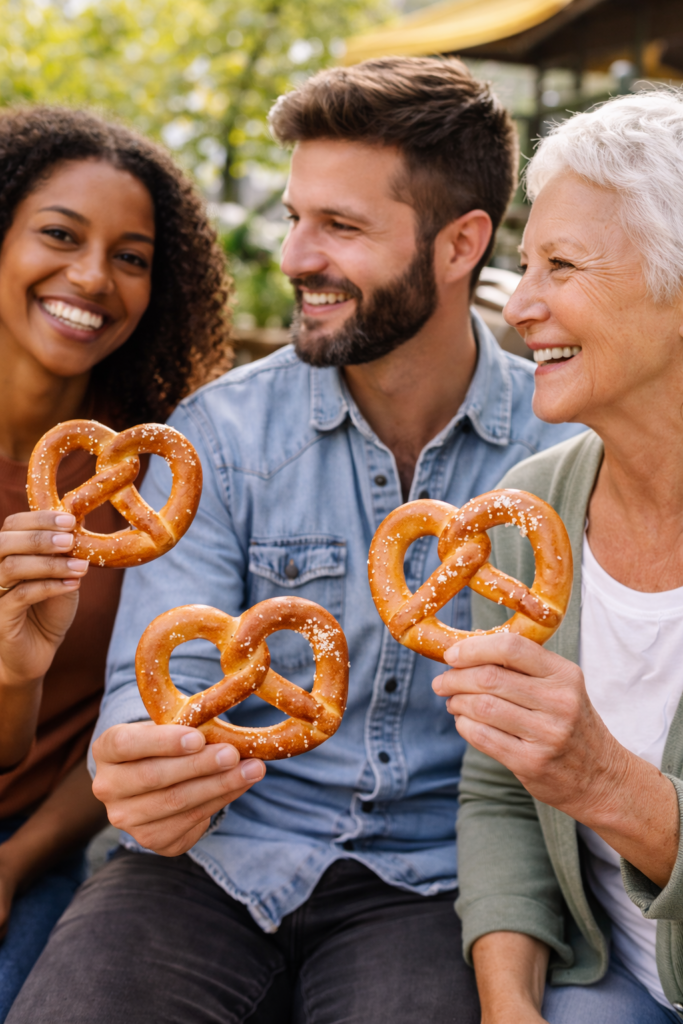
Some foods stand out because of their complexity. Others remain part of everyday life because they are simple, accessible, and easy to share.
Pretzels belong to the second category.
They are not usually associated with special occasions or elaborate preparation. They appear in ordinary settings. Cafés, gatherings, street stalls, or quick breaks during the day.
Yet, despite their simplicity, pretzels often become part of moments that feel connected.
National Pretzel Day brings attention to this connection. Not only to the food itself, but to the role it plays in everyday interaction.
What National Pretzel Day represents
National Pretzel Day is observed to celebrate the history, popularity, and cultural presence of pretzels.
The focus is not only on the product, but on how it has remained relevant across time.
Pretzels have moved through different settings. From traditional baking practices to modern snack culture, they have adapted while maintaining a familiar form.
This continuity makes them recognizable.
The day highlights how something simple can remain consistent while fitting into changing environments.
Why simple foods remain widely shared
Foods that are easy to access and easy to share tend to become part of everyday life.
Pretzels do not require special conditions. They are portable, uncomplicated, and suitable for different situations.
This makes them more likely to be included in shared experiences.
Complex foods may be reserved for specific occasions. Simple foods move more freely across contexts.
They fit into casual interactions, informal gatherings, and unplanned moments.
This flexibility contributes to their presence in shared experiences.
The connection between food and interaction
Food often acts as a point of connection.
It creates an opportunity for people to gather, pause, and engage with each other.
Pretzels, like many simple foods, are often consumed in social settings.
They are passed around, offered, or shared without formal structure.
This creates a space for interaction.
The focus is not only on the food, but on the moment in which it is consumed.
How familiarity influences shared experiences
Familiar foods require little explanation.
People already know what to expect.
This familiarity reduces barriers.
It allows attention to shift from the food itself to the interaction around it.
Pretzels are widely recognized. Their shape, taste, and texture are consistent.
This consistency supports shared experience.
It creates a common point of reference.
Why repetition strengthens connection
Foods that appear regularly become part of routine.
They are associated with repeated experiences.
Over time, these repetitions create connections.
A snack that is shared during breaks, gatherings, or casual conversations becomes linked to those moments.
Pretzels often appear in these repeated contexts.
Their presence becomes part of the experience, not separate from it.
The role of simplicity in communication
Simple foods do not require explanation.
They are easy to offer and easy to accept.
This simplicity supports interaction.
Offering a pretzel does not require preparation or formality.
It is a straightforward gesture.
This makes it easier for people to connect without additional structure.
Food as part of everyday culture
Food is not only about consumption. It is part of culture.
Pretzels have a history that connects to different regions and traditions. Over time, they have become part of broader food culture.
They appear in different forms and variations, but the core idea remains.
This cultural presence contributes to their familiarity.
It also supports their role in shared experiences.
How environments shape food experiences
The same food can be experienced differently depending on the environment.
A pretzel eaten at a quiet café is different from one shared at a crowded event.
The context influences the experience.
This highlights the importance of environment.
Food does not exist independently of where it is consumed.
National Pretzel Day brings attention to both the food and the contexts in which it appears.
Why shared moments do not require complexity
There is a tendency to associate meaningful experiences with elaborate settings.
In reality, shared moments often develop in simple situations.
A brief conversation, a pause during work, or a casual gathering.
Pretzels fit into these moments.
They do not require planning or structure.
Their presence is enough to support interaction.
The continuity of everyday traditions
Some traditions are formal and structured.
Others are informal and repeated without being defined.
Sharing simple food falls into the second category.
It is not always recognized as a tradition, but it occurs regularly.
Pretzels are part of this continuity.
They appear in everyday routines, contributing to repeated experiences.
How food supports informal connection
Not all interactions are planned.
Informal moments often lead to connection.
Food can support these moments by providing a shared activity.
Pretzels are often included in these situations.
They are easy to include without preparation.
This supports spontaneous interaction.
The balance between consistency and variation
Pretzels maintain a consistent form, but they also appear in different variations.
Soft pretzels, hard pretzels, salted or flavored versions.
This balance allows for both familiarity and variation.
It keeps the experience recognizable while allowing for change.
Why accessibility matters in shared experiences
Accessible foods are more likely to be shared.
Pretzels are widely available and affordable.
This accessibility contributes to their presence in different settings.
It allows more people to participate in shared experiences.
The role of food in everyday pauses
Daily routines include moments of pause.
Breaks during work, transitions between activities, or short periods of rest.
Food often becomes part of these pauses.
Pretzels fit into these moments.
They provide a simple way to step away from routine and engage with others.
What National Pretzel Day brings into focus
National Pretzel Day highlights more than a specific food.
It brings attention to how simple items become part of everyday interaction.
It encourages awareness of moments that might otherwise go unnoticed.
The day provides an opportunity to reflect on how shared experiences develop.
How meaning extends beyond the day
The significance of National Pretzel Day is not limited to one date.
Pretzels continue to be part of everyday life.
The interactions they support continue as well.
The day acts as a reminder.
It highlights something that is already present.
Where simple foods create connection
Simple foods do not need to be complex to be meaningful.
Their value often lies in how they are shared.
Pretzels are one example of this.
They exist within everyday life, supporting moments of interaction.
These moments may not be structured or planned, but they contribute to connection.
National Pretzel Day brings attention to this.
It shows that shared experiences often develop through simple, familiar elements that are part of daily life.
Related FAQs
National Pretzel Day is celebrated to recognize the history, popularity, and cultural significance of pretzels as a widely loved snack.
Pretzels are simple, accessible, and easy to share, making them a common part of social interactions, casual gatherings, and everyday connections.
Simple foods bring people together without formality. They create opportunities for conversation, interaction, and shared experiences in everyday life.
Their convenience, variety, and familiarity make pretzels a versatile snack that fits into different environments and occasions.
No, it also highlights how everyday foods contribute to social connection, shared experiences, and cultural traditions.