In today’s fast-paced digital world, the way we communicate has changed significantly. From quick text messages to long, thoughtful emails, people constantly choose between keeping messages short or expressing themselves in detail. But which approach works better—short messages or long messages?
The answer is not as simple as choosing one over the other. Both short and long messages serve different purposes, and their effectiveness depends on context, intent, and the relationship between the people communicating.
Understanding when to use each can improve clarity, avoid misunderstandings, and make your communication more impactful.
What Are Short Messages?
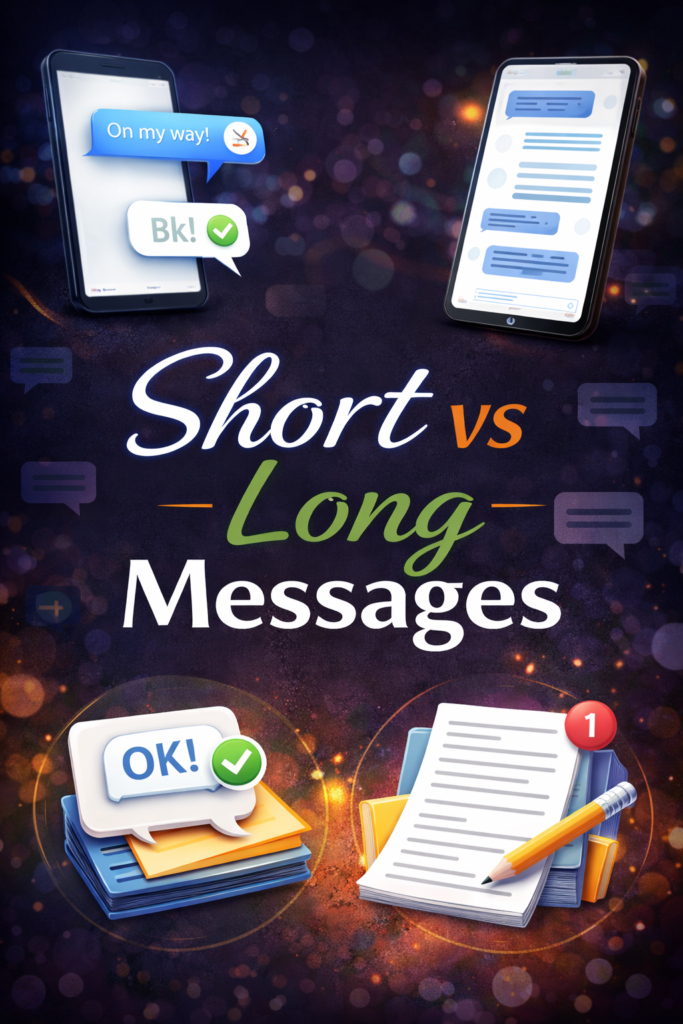
Short messages are brief, direct, and to the point. They are designed to communicate information quickly without unnecessary details.
Examples include:
- “I’ll call you later.”
- “Meeting at 3 PM.”
- “Sorry for the delay.”
Short messages are widely used in texting, chat apps, and quick workplace communication. They prioritize speed and convenience.
What Are Long Messages?
Long messages provide more detail, context, and explanation. They are used when the situation requires clarity, emotional depth, or thorough understanding.
Examples include:
- Explaining a situation or decision
- Expressing feelings in detail
- Providing instructions or feedback
Long messages are common in emails, formal communication, and emotional conversations where nuance matters.
Key Differences Between Short and Long Messages
Both types of communication have distinct characteristics that affect how messages are received and interpreted.
| Aspect | Short Messages | Long Messages |
|---|---|---|
| Length | Brief and concise | Detailed and extended |
| Speed | Quick to write and read | Takes more time |
| Clarity | Direct but sometimes limited | More context and explanation |
| Emotional Depth | Limited | High |
| Use Case | Quick updates, casual chats | Important discussions, explanations |
| Risk | Can feel abrupt or unclear | Can feel overwhelming or too long |
This comparison shows that short messages focus on efficiency, while long messages focus on depth and understanding.
Speed vs Clarity
Short messages are ideal when speed is important. They allow quick communication and immediate responses, which is why they dominate texting and chat platforms.
However, speed can come at the cost of clarity. Without enough context, short messages can sometimes be misunderstood.
Long messages, on the other hand, take more time but provide clarity. They allow you to explain your thoughts fully, reducing the chances of confusion.
Emotional Expression and Tone
One of the biggest limitations of short messages is emotional expression. A brief message may come across as cold or indifferent, even if that wasn’t the intention.
Long messages allow you to express tone, भावना, and intention more clearly. This is especially important in relationships, apologies, or sensitive conversations.
For example, a simple “Sorry” may not carry the same weight as a thoughtful apology that explains your feelings and intentions.
When Short Messages Work Best
Short messages are most effective when communication needs to be quick and straightforward.
They are ideal for:
- Quick updates
- Confirmations
- Casual conversations
- Immediate responses
- Simple questions
In these situations, adding unnecessary detail can slow down communication.
When Long Messages Work Best
Long messages are better suited for situations that require depth, clarity, or emotional connection.
They are ideal for:
- Explaining complex ideas
- Apologizing or resolving conflicts
- Expressing feelings
- Giving detailed instructions
- Important discussions
In these cases, a short message may not be enough to convey the full meaning.
The Risk of Miscommunication
Short messages often lack context, which can lead to misunderstandings. Tone is especially difficult to interpret in brief texts.
Long messages reduce this risk by providing more information, but they can also overwhelm the reader if they are too lengthy or unclear.
The key is to balance clarity with simplicity.
Attention Span and Modern Communication
Modern communication trends show a preference for shorter messages due to reduced attention spans and fast-paced lifestyles. People often prefer quick, easy-to-read content.
However, this does not mean long messages are ineffective. When the situation demands it, people are willing to engage with detailed communication—especially when it is meaningful or important.
Choosing the Right Approach
The effectiveness of short vs long messages depends on three key factors:
- Purpose: What are you trying to communicate?
- Context: What is the situation?
- Relationship: Who are you communicating with?
A quick update to a colleague may only need a short message, while an apology to a loved one may require a longer, more thoughtful response.
Finding the Right Balance
The most effective communication often combines both approaches. A message can be concise while still providing enough context to be understood.
For example, instead of writing a very long message, you can keep it structured and clear. Similarly, instead of sending a very short message, you can add just enough detail to avoid confusion.
Communication That Fits the Moment
There is no universal rule for choosing between short and long messages. Each situation is different, and the best communicators are those who can adapt their style based on the moment.
If you’re exploring how communication works across different platforms, you can also check Email vs Slack vs Chat or Digital Communication vs Face-to-Face Communication to understand how context shapes communication choices.
Making Your Messages More Effective
Whether short or long, the goal of any message is to be understood. Clarity, intention, and timing matter more than length.
Short messages work when speed and simplicity are needed. Long messages work when depth and understanding are required. By choosing the right approach for each situation, you can ensure that your communication is not only efficient but also meaningful.
In the end, it’s not about how many words you use—it’s about how well your message connects.
Related FAQs
Short messages are brief and direct, used for quick communication, while long messages provide detailed explanations, context, and emotional depth for better understanding.
Short messages are best for quick updates, confirmations, and casual conversations where speed and clarity are more important than detail.
Long messages can be more effective in complex or emotional situations because they provide clarity and context, but they may not be necessary for simple communication.
Short messages often lack tone and context, which can lead to misinterpretation of intent, especially in text-based communication.
You should choose based on the situation, purpose, and relationship. Use short messages for quick communication and long messages when clarity, emotion, or explanation is needed.