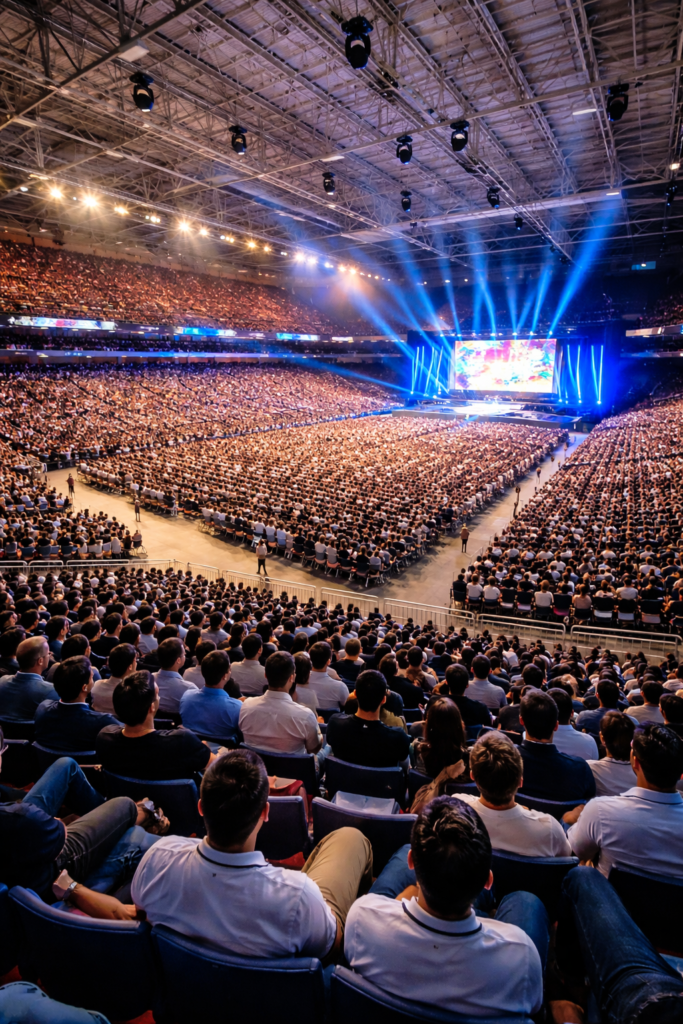
Large indoor stadium venues present a different communication challenge compared to traditional convention environments. When thousands of attendees gather in a single enclosed space, messaging must be highly visible, carefully timed, and consistently delivered across multiple touchpoints. Without structured communication, even well-organised events can face crowd congestion, confusion, and operational delays.
The Dome at America’s Center is designed to host high-capacity events such as conventions, exhibitions, sporting events, and large-scale conferences. The scale of the venue, combined with concentrated audience movement and centralized programming, requires a communication strategy tailored specifically for stadium-style environments.
This article outlines a communication planning framework for stadium-scale events and explains how organisers can coordinate messaging effectively across large audiences.
Understanding Communication Complexity in Stadium-Scale Venues
Unlike multi-hall convention centres, stadium environments concentrate thousands of attendees into a single, expansive space. This creates communication challenges that are distinct from traditional event settings.
Key characteristics include:
- High-density crowd movement
- Simultaneous audience engagement
- Limited transition windows between sessions
- Large viewing distances from stage and screens
- Centralised announcements affecting all attendees
Communication in such environments must be:
- Visible from long distances
- Repeated across multiple channels
- Structured to guide movement and behaviour
- Prioritised based on urgency
Communication Challenges in Large Indoor Dome Venues
Managing High-Density Crowd Movement
When large audiences enter or exit at the same time, movement becomes difficult to control. Clear communication is required to guide attendees toward:
- Entry gates
- Seating sections
- Queue zones
- Restroom facilities
- Exit routes
Directional signage, announcements, and staff coordination must work together to prevent bottlenecks.
Visibility Across Large Spaces
Attendees may be seated far from the stage or screens. Communication must therefore rely on:
- Large-format digital displays
- Repeated announcements
- Section-based signage
- Visual cues
Messages should be concise and easy to interpret quickly.
Limited Individual Support
In stadium-scale environments, staff cannot assist every attendee individually. Communication must therefore be designed for self-navigation.
This includes:
- Clear venue maps
- Section identifiers
- Colour-coded zones
- Simple directional language
When communication is intuitive, attendees rely less on manual support.
Pre-Event Communication Strategy for Stadium Events
Pre-event communication reduces pressure on on-site operations by preparing attendees in advance.
Information to Share Before the Event
- Entry gate allocation
- Seating sections
- Security screening guidelines
- Arrival time recommendations
- Parking and transportation information
- Key schedule highlights
Segment messaging based on:
- General attendees
- VIP guests
- Speakers
- Media
- Staff and volunteers
Clear pre-event communication improves arrival flow and reduces confusion.
On-Site Communication Framework for Large Dome Events
Primary Communication Channels
- Large digital screens
- Public address system
- Event mobile application
- Directional signage
- Help desks
- Staff communication points
Using multiple channels ensures message redundancy and wider reach.
Messaging Priority Structure
To avoid overload, communication should follow a hierarchy:
- Safety and crowd movement instructions
- Session timing updates
- Operational announcements
- Engagement and promotional messaging
This ensures critical information remains visible.
Real-Time Communication Planning
Large-scale indoor venues require rapid communication updates during the event.
Prepare messaging for:
- Session delays
- Entry gate adjustments
- Seating changes
- Technical issues
- Emergency announcements
A central communication command centre should approve and distribute messages to maintain consistency.
Stakeholder Coordination for Stadium Events
Communication planning must align multiple operational teams:
- Event organisers
- Venue operations
- Security teams
- Production and AV teams
- Volunteer coordinators
- Registration teams
Daily briefings and shared communication protocols ensure stakeholders deliver consistent messaging.
Technology Supporting Stadium-Scale Communication
Technology plays a key role in delivering communication across large audiences.
Recommended tools include:
- Central announcement systems
- Digital signage management platforms
- Push notification tools
- Event mobile applications
- Communication dashboards
Technology helps synchronise messaging across screens, announcements, and digital channels.
Measuring Communication Effectiveness in Dome Events
Organisers can evaluate communication performance using:
- Entry queue duration
- Help desk query volume
- App engagement metrics
- Crowd flow efficiency
- Attendee feedback
- Incident response time
These insights support improvements for future events.
Coordinating Communication Across Multiple Venues
Large events may span both stadium and convention environments. For example, breakout sessions may take place at America’s Center Convention Complex while keynote presentations occur inside the dome.
This requires:
- Unified communication strategy
- Shared signage terminology
- Coordinated timing announcements
- Integrated attendee guidance
For broader communication planning across multi-hall environments, refer to the companion guide on communication strategy for America’s Center Convention Complex. Combining both approaches helps organisers manage multi-venue events effectively.
Communication Planning for High-Capacity Indoor Events
In high-capacity indoor venues, communication becomes the primary tool for guiding behaviour, ensuring safety, and delivering a cohesive experience. Structured messaging supports navigation, reduces uncertainty, and improves coordination among stakeholders.
At The Dome at America’s Center, the scale of the environment requires organizers to prioritize clarity, visibility, and timing. When communication is designed intentionally, even large audiences can move efficiently, engage confidently, and experience a well-coordinated event journey.
Related FAQs
Communication planning is essential due to the large seating capacity, centralized programming, and high attendee density. Clear messaging helps manage crowd flow, improve navigation, and ensure safety during large-scale events.
Organizers should use directional signage, section-based announcements, and digital screens to guide attendees to seating zones, entry points, and exits efficiently. Structured messaging prevents congestion and delays.
Effective channels include large-format screens, public address systems, event mobile apps, staff guidance points, and clearly marked signage placed throughout the venue.
When events span both the dome and America’s Center Convention Complex, organisers should use unified messaging, shared schedules, and consistent navigation instructions across locations.
Pre-event communication should include entry gates, seating sections, security procedures, arrival timings, parking information, and key session highlights to reduce on-site confusion.